
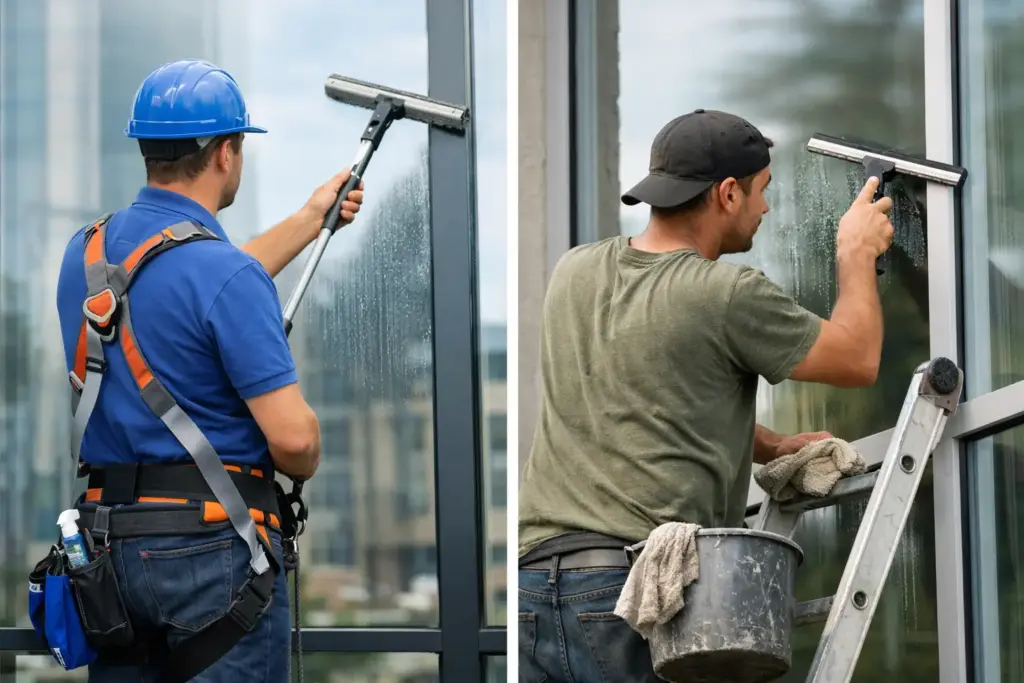
A window cleaner may spend only a few hours at your home, storefront, or office, but the risk involved can last much longer if something goes wrong. When comparing insured versus uninsured window cleaners, the difference is not simply a line item on a quote. It is a question of who may be responsible if a worker is injured, a ladder damages siding, or a window is accidentally broken.
For homeowners and property managers across Pittsburgh and Western Pennsylvania, hiring an insured professional is one practical way to protect the property, the people working on it, and the budget set aside for maintenance. A lower price can be appealing, but it should never be the only deciding factor when work involves ladders, elevated windows, glass, and exterior access.
Professional window cleaning involves more than a bucket and a squeegee. Technicians may work from ladders, use extension poles around landscaping and electrical lines, access upper-story windows, and move around wet surfaces. Commercial work can add pedestrian traffic, storefront glass, parking areas, and building access requirements.
Even careful, experienced workers can encounter an unexpected problem. A ladder can shift on uneven ground. A gust of wind can affect equipment. Aging glass, loose screens, brittle window seals, and hidden defects can become apparent during routine service. Insurance does not prevent every incident, but it creates a clear path for handling an accident without placing the entire burden on the customer.
A legitimate window cleaning company should be prepared to discuss its coverage in straightforward terms. That willingness matters. It shows the company treats safety and accountability as part of the service, not as an afterthought.
An insured cleaner generally carries coverage intended to respond to common risks connected with the work. The specific policy limits and protections vary by company, but two coverages are especially relevant: general liability insurance and workers’ compensation coverage.
General liability insurance may help address accidental property damage or third-party injuries connected to the job. For example, if a tool damages a window, a ladder scratches a vehicle, or a passerby is hurt because of a work-related hazard, a properly insured business has a process for reporting and addressing the claim.
Workers’ compensation coverage addresses another major concern: injury to the cleaner or a member of the crew. Window cleaning can involve elevated work and physical labor. If an uninsured individual is injured while working at your property, questions about financial responsibility can become complicated very quickly. The details depend on the work arrangement, the circumstances, and applicable law, but it is a situation no property owner wants to sort out after an accident.
An uninsured cleaner may still be skilled, polite, and less expensive. That does not remove the exposure. If damage or injury occurs, the customer may have fewer protections, less documentation, and more uncertainty about how costs will be handled. Saving a modest amount on a cleaning appointment can become expensive if an incident leads to repairs, medical expenses, or a dispute.
For a homeowner, window cleaning often means work near the parts of the property that are costly to repair: glass, frames, screens, siding, trim, gutters, landscaping, decks, and vehicles in the driveway. It may also mean a technician working near family members, guests, pets, or neighbors.
Insurance provides reassurance that the company has considered those risks before arriving at your home. It also encourages professional operating habits. Insured companies are more likely to use appropriate equipment, train their employees, document their work, and follow basic jobsite safety practices because they have an ongoing business to protect.
That does not mean every problem automatically becomes an insurance claim. Small issues can often be resolved directly and professionally. The value of coverage is that there is an established backstop if the problem is significant. A responsible company should communicate promptly, document what happened, and work toward a fair resolution.
Homeowners should also remember that the person at the door may not be the person who owns the business. Ask whether the workers are employees or independent contractors, whether the company carries workers’ compensation coverage when applicable, and whether the crew is trained for the type of access your home requires. A second-story window over a sloped yard deserves more planning than a ground-floor storefront pane.
For commercial property managers and business owners, the stakes can be even broader. Window cleaners may be working where customers, tenants, delivery drivers, and employees are moving through the property. A wet walkway, improperly placed ladder, or damaged storefront window can affect business operations and the customer experience.
Commercial clients also need dependable scheduling and clear accountability. A window cleaning crew that arrives as promised, uses professional equipment, and carries insurance is easier to coordinate with than an informal provider who cannot supply basic business documentation. For offices, retail locations, medical practices, and multi-tenant properties, that reliability supports both safety and presentation.
Before authorizing work, commercial decision-makers should confirm that the provider’s coverage fits the job. Some properties have vendor requirements, certificate requests, access rules, or specific limits established by leases and building policies. A qualified local company should be able to have a practical conversation about these requirements before work begins.
You do not need to become an insurance expert to make a sound hiring decision. Start by asking whether the company is licensed and insured, then ask for proof of insurance if the work involves elevated access, a larger property, or a commercial site. A professional provider should not treat that request as unreasonable.
Look for documentation that identifies the business, the active policy period, and the relevant coverage. If a certificate is provided, make sure the business name matches the company you are hiring. If anything seems unclear, ask the company to explain it. Vague answers, reluctance to provide documentation, or pressure to skip the question are useful warning signs.
It is also reasonable to ask how the company handles accidental damage. The answer should be calm and specific. You are not looking for a promise that nothing can ever happen. You are looking for evidence that the provider has a responsible process when something does.
For larger commercial work, ask the property manager or building owner whether they have vendor insurance requirements before scheduling service. Handling that step early prevents delays on cleaning day.
An uninsured cleaner may quote a lower rate because they have fewer business expenses. Insurance, training, payroll practices, safety equipment, background checks, and reliable scheduling all cost money. Those costs are also part of what separates a casual arrangement from a professional service relationship.
That does not mean the highest quote is automatically the best one. Compare what each provider is actually offering. Are interior and exterior panes included? Are screens, tracks, or hard-water deposits addressed? Does the company have experience with your property type? Will the work be completed by a background-checked crew? Is the estimate clear about the scope of service?
A fair quote should help you understand the value behind the number. The best choice is often the provider that combines reasonable pricing with clear communication, proper coverage, dependable scheduling, and a standard of work you can trust.
A brief conversation before booking can prevent a great deal of uncertainty later. Ask whether the company carries general liability insurance and workers’ compensation coverage, where applicable. Confirm whether the people doing the work are employees or subcontractors. Discuss access challenges such as steep grades, high windows, locked gates, pets, fragile landscaping, or customer traffic near a commercial entrance.
You can also ask about the crew’s approach to ladders, window screens, and delicate or older windows. An experienced company will not overcomplicate the answer, but it should be able to explain how it evaluates the job and protects the property.
At A Clearvue, our insured, licensed, and background-checked team serves homeowners and commercial properties with the kind of care local customers expect. A free estimate gives you the opportunity to discuss your property, your priorities, and any access concerns before the work is scheduled.
Clean windows should leave your property looking better, not leave you wondering what could happen if a job goes wrong. Choose a provider that is prepared to do the work carefully and stand behind it, then enjoy the clearer view with confidence.




* Suspended Grids / False Grids – the grids are between your panes of glass.

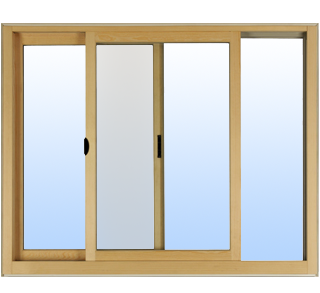


* Fixed / non-removable grids – These are windows with non-removable obstructions making the window look and feel like individual pieces of glass.